
Today we’re diving into the world of glass to help you decide whether tempered or laminated glass is right for your project. Whether you’re designing a modern home, revamping a storefront, or working on a custom installation, understanding the differences between these two types of glass can make all the difference. Read on for an in-depth look at how each is made, their unique benefits, and common applications.
Tempered Glass: What It Is, How It Works & When to Use It
Tempered glass is heat-treated safety glass designed to be stronger than standard annealed glass and to break into small pieces rather than large, sharp shards if it fails. It is commonly used in applications where additional strength and safety are important, including doors, shower enclosures, tabletops, commercial spaces, architectural installations, mirrors, and other exposed glass applications.
At Two Way Mirrors, we offer custom glass fabrication and tempering for many of our glass and mirror products.
What Is Tempered Glass?
Tempered glass is glass that has undergone a controlled heating and rapid cooling process to increase its strength.
Standard annealed glass is heated to a high temperature and then rapidly cooled. This process creates compressive stress at the surface of the glass while the interior remains under tensile stress.
The resulting glass is significantly stronger than ordinary annealed glass and has different breakage characteristics.
How Is Tempered Glass Made?
Tempered glass begins as regular annealed glass.
Before tempering, the glass is:
- Cut to its final dimensions.
- Fabricated with any required holes, notches or special shapes.
- Edge-finished when necessary.
- Thoroughly cleaned.
- Heated in a tempering furnace.
- Rapidly cooled using high-pressure air.
The rapid cooling process causes the outside surfaces to cool faster than the center, creating the internal stresses that give tempered glass its increased strength.
Once this process is complete, the glass cannot normally be cut or drilled without causing it to break.

How Strong Is Tempered Glass?
Tempered glass is significantly stronger than standard annealed glass of the same thickness.
This additional strength makes it useful for installations where glass may experience greater impact, mechanical stress or changes in temperature.
However, tempered glass is not unbreakable.
A sufficiently strong impact—particularly around an edge—or damage to the glass can still cause it to fail.
What Happens When Tempered Glass Breaks?
One of the biggest differences between tempered and regular glass is how they break.
Standard annealed glass can break into large, sharp pieces.
Tempered glass is designed so that when it fails, the stored stresses cause the sheet to fracture into many relatively small pieces rather than several large shards.
Tempered Glass vs. Regular Glass
The primary difference between tempered and regular annealed glass is that tempered glass has undergone additional heat treatment to improve its strength and change its breakage characteristics.
| Feature | Tempered Glass | Regular Annealed Glass |
|---|---|---|
| Heat treated | Yes | No |
| Strength | Higher | Lower |
| Breakage | Small pieces | Larger, sharper shards |
| Can be cut after manufacturing | No | Yes |
| Can be drilled after manufacturing | No | Yes |
| Custom fabrication | Must be completed before tempering | Can generally be fabricated afterward |
| Common use | Safety and high-strength applications | General-purpose |
Does Tempering Cause Glass Distortion?
Tempering will introduce some optical distortion because the glass undergoes intense heating and rapid cooling.
This can be particularly noticeable with mirrors, where even small changes in glass flatness may become visible in the reflected image.
Tempered mirror products can show reflection distortion, including around the perimeter. For applications where extremely accurate reflection is more important than impact resistance, this should be considered when deciding whether tempering is necessary.
When Should You Use Tempered Glass?
Tempered glass is commonly considered for applications where additional strength or safer breakage characteristics are important.
Common applications include:
- Shower doors and enclosures
- Glass doors
- Tabletops
- Shelving
- Architectural glass
- Commercial installations
- Public installations
- Glass partitions
- Outdoor projects
Building codes may require tempering in certain locations, so requirements for a specific installation should always be verified before selecting the glass.
Can Two Way Mirrors Be Tempered?
Yes. Certain glass two way mirrors can be tempered.
Tempering can be useful when the mirror will be installed in a location where additional strength or safety is desired.
However, tempering can introduce some reflection distortion. For observation rooms or other projects where both safety and reflection quality matter, tempered, laminated, or tempered-and-laminated options should be evaluated based on the installation requirements.
Tempered Glass vs. Laminated Glass
Tempered and laminated glass are both used when additional safety is desired, but they work differently.
Tempered glass gets its strength and breakage characteristics from heat treatment.
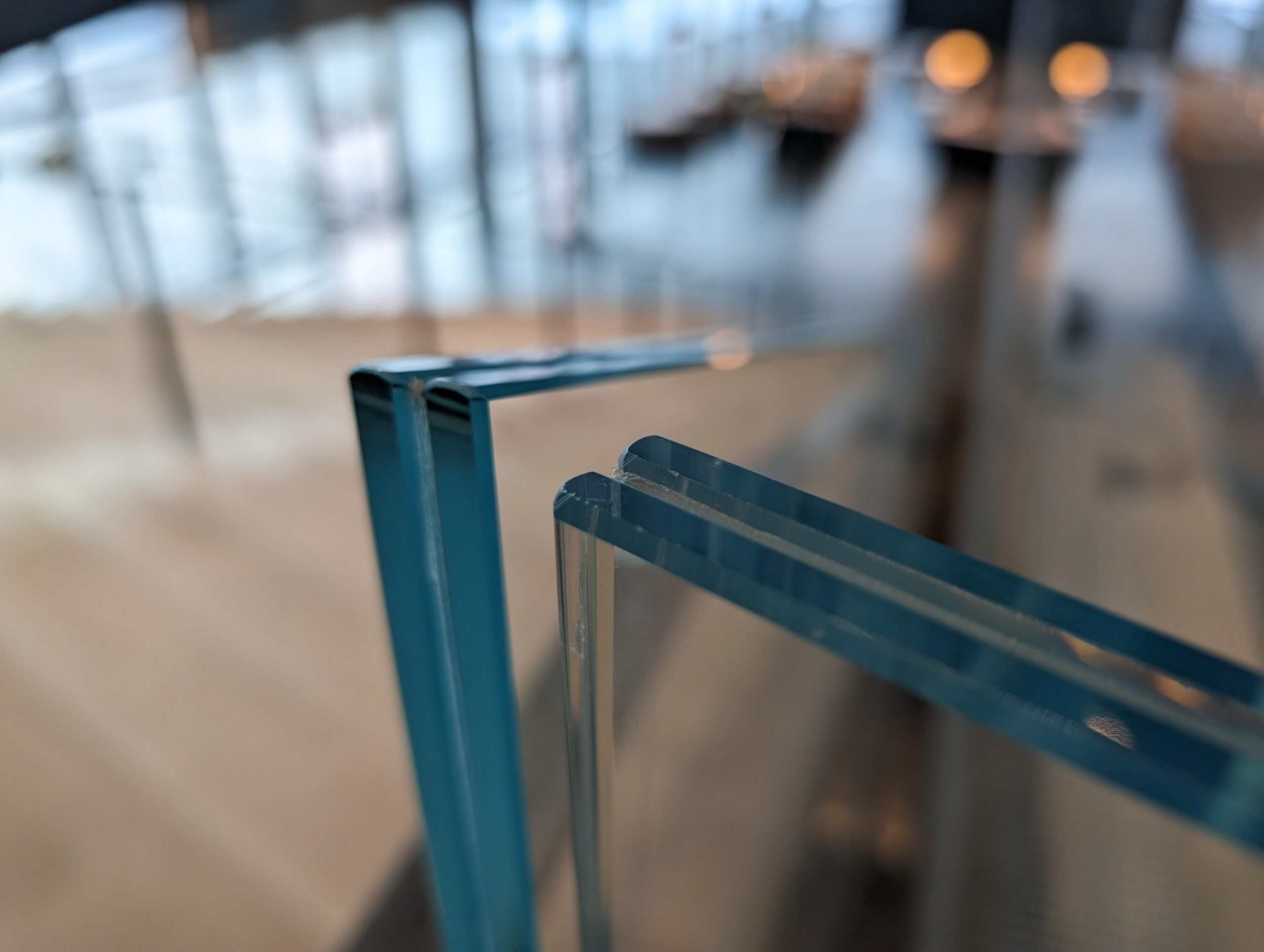
Laminated glass consists of multiple layers of glass bonded together with an interlayer. When laminated glass breaks, the interlayer helps hold the broken glass together.
| Feature | Tempered Glass | Laminated Glass |
|---|---|---|
| Construction | Heat-treated glass | Multiple layers bonded together |
| Main advantage | Increased strength | Glass remains held together after breakage |
| Breakage behavior | Breaks into many small pieces | Cracks but tends to remain attached to interlayer |
| Post-breakage retention | Low | High |
| Common applications | Doors, showers, tables, public installations | Windshields, security glazing, sound control |
For applications requiring additional protection, some glass products can be both tempered and laminated.
Two Way Mirrors offers tempered and laminated configurations for certain mirror products.
What is laminated glass?
Typically, two glass panes—either annealed or tempered—are selected and paired with a chosen interlayer. Polyvinyl Butyral (PVB) is popular for its clarity and adhesion, though it’s generally suited for indoor use. Alternatively, Ethylene-Vinyl Acetate (EVA) is favored for decorative or outdoor applications. The interlayer is carefully sandwiched between the glass panes, often pre-laminated by passing the assembly through rollers to eliminate air pockets. The final step involves placing the “sandwich” in an autoclave, where heat and pressure bond the layers together. After controlled cooling, the laminated glass is thoroughly inspected for any defects.
Applications: Where Safety Meets Style
Tempered Glass
-
High Impact Resistance: Its ability to shatter into small, less dangerous pieces makes it perfect for windows, doors, and other areas where safety is a priority.
-
Versatile Use: From shower enclosures and bathroom partitions to automotive side and rear windows, tempered glass is a popular choice across various industries.
-
Aesthetic and Functional: Tempered glass is not only strong but also suitable for decorative elements like tabletops and glass shelves, where both beauty and durability are key.

Laminated Glass
-
Safety First: When broken, the glass fragments typically stick to the interlayer, reducing the risk of injury.
-
Security & Weather Resistance: Its added strength helps deter forced entry and withstand severe weather conditions, including hurricanes.
-
Sound Insulation & UV Protection: The interlayer can dampen sound and block harmful UV rays, making it ideal for automotive windshields, building facades, skylights, and more.

Making the Choice
When deciding between tempered and laminated glass, consider your project’s specific needs:
-
Tempered Glass is ideal if you need extreme strength and safer breakage.
-
Laminated Glass offers enhanced security, soundproofing, and additional safety benefits in situations where keeping the glass intact is crucial.
At Two Way Mirrors, we offer both tempered clear glass and laminated options, including our signature two way mirror glass. If you have a special project or need expert advice on choosing the right glass, please don’t hesitate to reach out. You can explore our products at twowaymirrors.com or email us at sales@twowaymirrors.com.
Thanks for reading, and we look forward to helping you find the perfect glass solution for your next project!